Learners Licence Booking South Africa 2026: Requirements, Steps & Fees
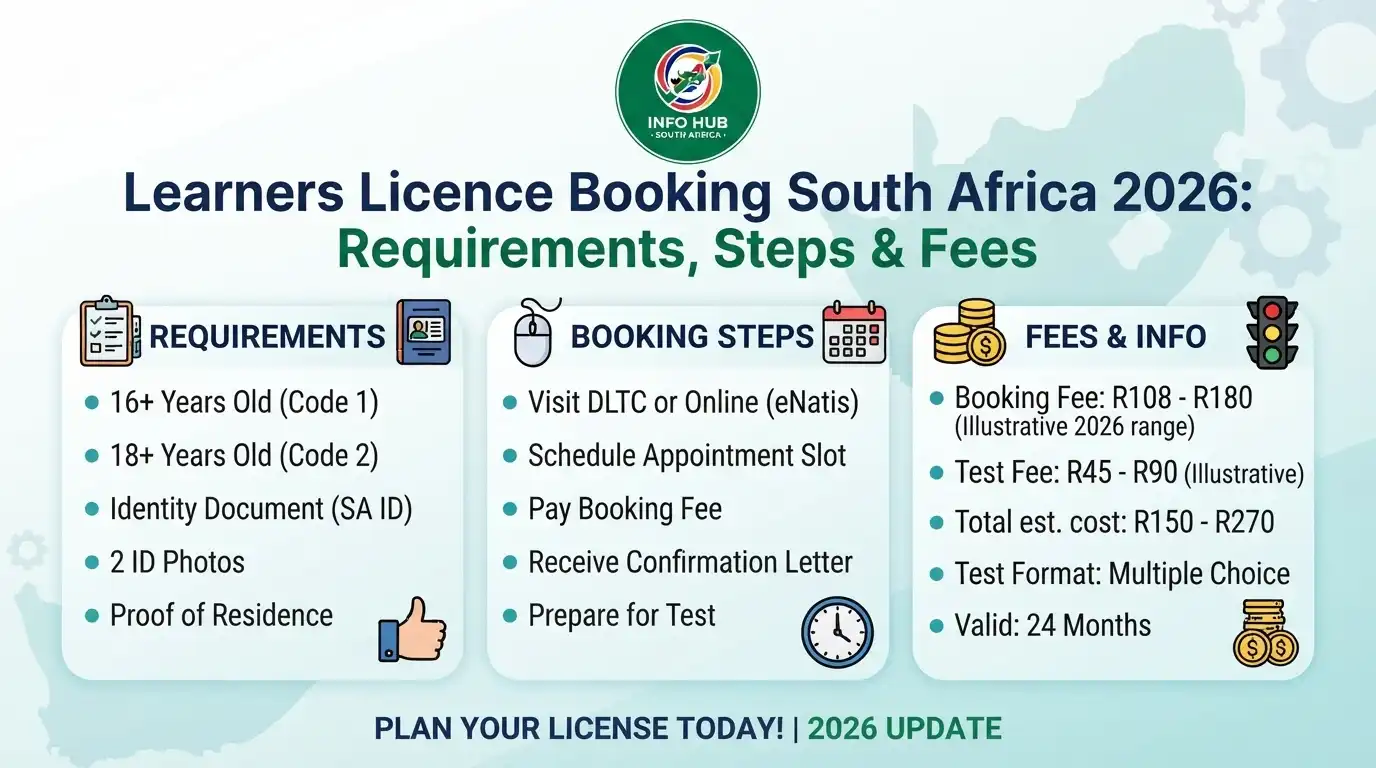
Getting a learner’s licence is the first major step towards becoming a legally licensed driver in South Africa. Before you can take a practical driving test, you need to pass the learner’s licence test and obtain a valid learner’s licence.
For people searching for learners licence booking online, the process can vary depending on where you live. The South African Government states that learner’s licence applications are handled through Driving Licence Testing Centres (DLTCs), while Gauteng residents should use the online NaTIS system for their learner’s licence application.”Visit Homepage for more”.
Learner’s Licence at a Glance
A learner’s licence is a legal permit showing that you have basic knowledge of motor vehicles and South African road rules. It allows you to drive only while supervised by a person who holds the appropriate full driving licence.
The licence remains valid for 24 months and cannot be extended. This makes it important to plan your practical driving lessons and driving licence application within the validity period.
| Information | Details |
|---|---|
| Licence | Learner’s licence |
| Validity | 24 months |
| Test location | Driving Licence Testing Centre (DLTC) |
| Application form | LL1 |
| Eye test | Required |
| Booking method | DLTC; online application for Gauteng residents |
| Licence issued | Same day after passing and paying the issue fee |
| Main test subjects | Road signs, road rules and vehicle controls |
What Is Learners Licence Booking?
Learners licence booking is the process of arranging a date and time to write the learner’s licence test at an approved Driving Licence Testing Centre.
The booking should not be confused with simply studying for the test. You need to submit the required information, provide the relevant documents, pay the booking fee and receive confirmation of your test appointment.
If you are searching for learners licence booking online, first check whether your province or municipality provides an online booking service. The national government service page specifically states that all Gauteng residents should apply online through NaTIS.
Who Can Apply for a Learner’s Licence?
Your minimum age depends on the vehicle category you want to operate.
Code 1 – Motorcycles
Code 1 covers motorcycles, including motorcycles with or without a sidecar, as well as motor tricycles and quadricycles.
If the motorcycle engine does not exceed 125cc, you must be at least 16 years old on the date of the test. For motorcycles with an engine capacity above 125cc, the minimum age is 18.
Code 2 – Light Motor Vehicles
Code 2 applies to motor vehicles such as cars, minibus vehicles, buses and goods vehicles with a gross vehicle mass of no more than 3,500kg.
The applicant must be at least 17 years old on the date of the learner’s licence test.
Code 3 – Heavy Motor Vehicles
Code 3 is intended for motor vehicles with a gross vehicle mass exceeding 3,500kg.
The minimum age for this category is 18 years on the date of the test.
Documents to Prepare Before Your Booking
Having your documents ready can make the booking process much smoother. The South African Government lists an identity document, photographs, booking fee and proof of postal and residential address among the requirements.
Prepare the following:
What About the LL1 Form?
The Application for a Learner’s Licence form (LL1) is part of the application process. The government says the form is available at a DLTC and through eNatis.
Applicants aged 65 or older must also complete a Medical Certificate form (MC).
How to Start Learners Licence Booking Online
If online booking is available for your location, use the official government-supported system for that area.
For Gauteng residents, the current government guidance directs applicants to NaTIS for online learner’s licence applications.
Step 1: Open the Official NaTIS Website
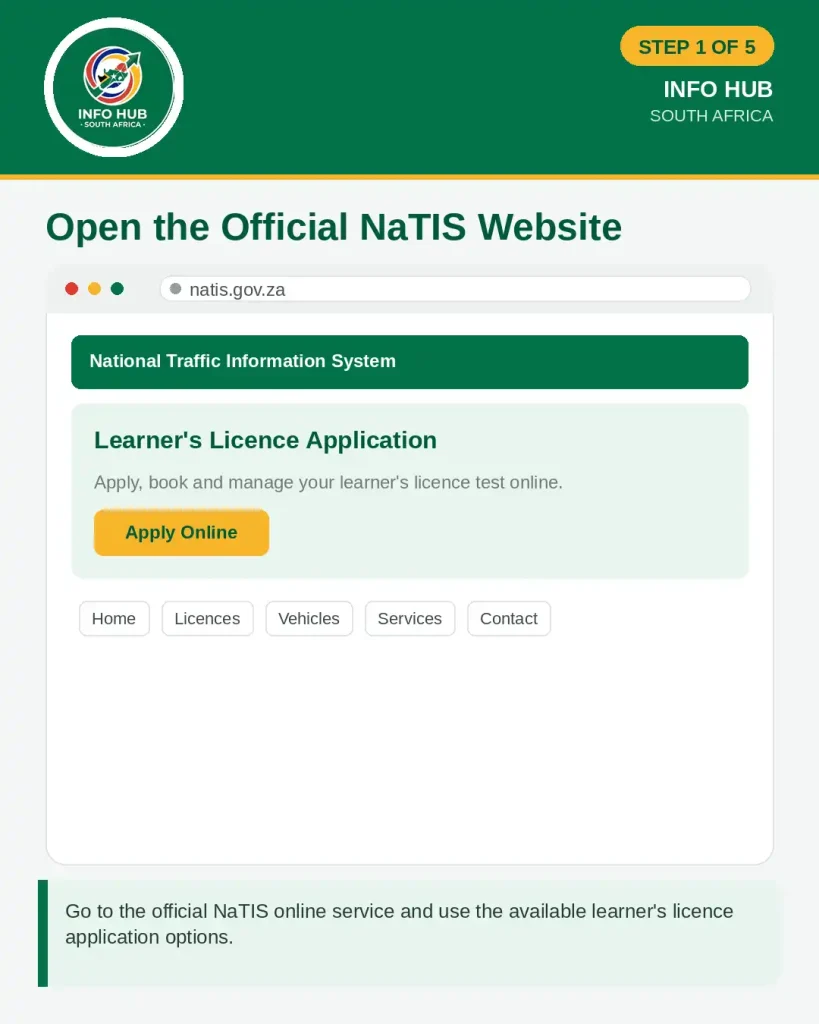
Go to the official NaTIS online service and use the available learner’s licence application options.
Step 2: Enter Your Details
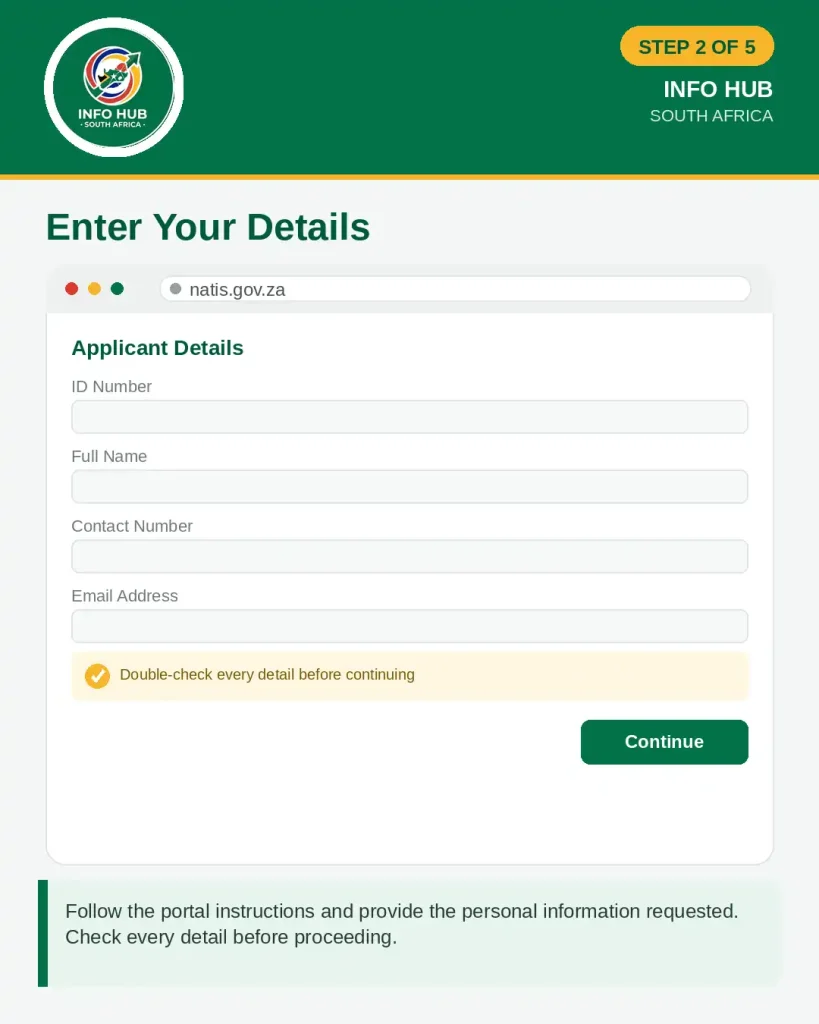
Follow the portal instructions and provide the personal information requested for the application. Check every detail carefully before proceeding because incorrect information can create problems with your booking.
Step 3: Select the Relevant Test Service
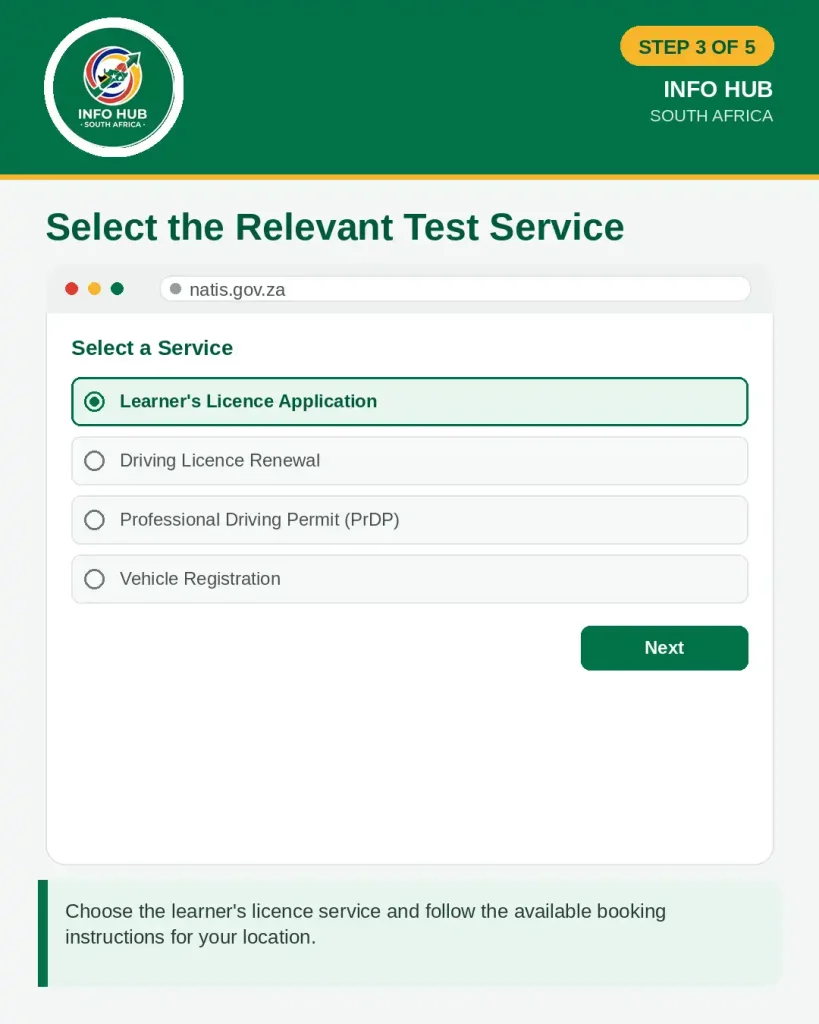
Choose the learner’s licence service and follow the available booking instructions for your location.
Step 4: Choose an Available Appointment
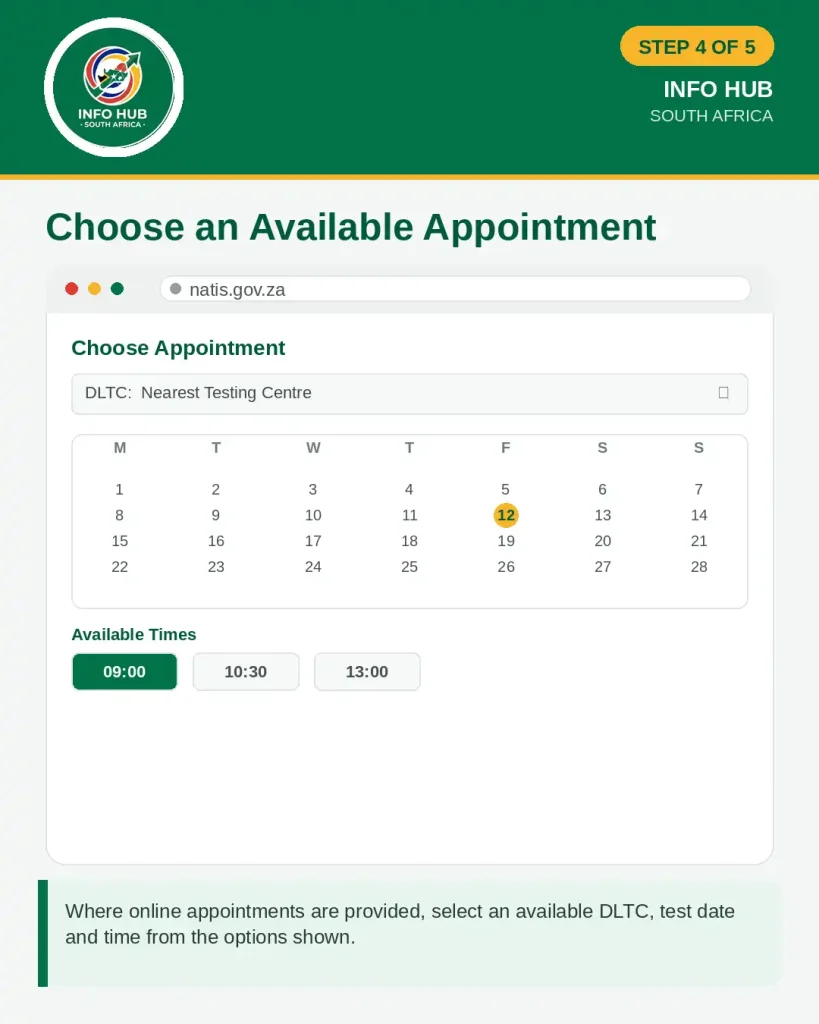
Where online appointments are provided, select an available DLTC, test date and time according to the options displayed by the official system.
Step 5: Keep Your Confirmation
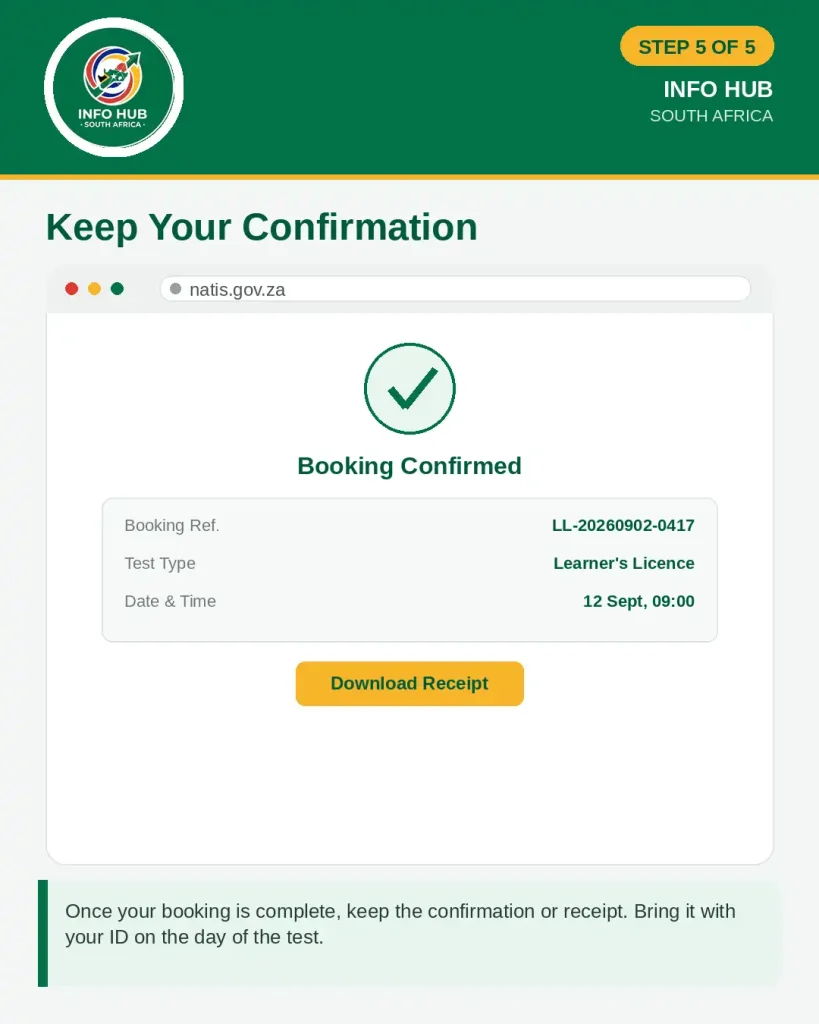
Once your booking has been completed, keep the booking confirmation or receipt. The government states that you must present your booking receipt and ID on the day of the test.
Important: Online availability is not necessarily the same across every South African province. If the official online service does not support your location, contact or visit your nearest DLTC and follow its local booking procedure.
Booking at a DLTC Instead
If online booking is not available for your area, the government’s general process is to visit the nearest Driving Licence Testing Centre to book and confirm a test date.
Take your required documents and booking fee with you. The DLTC will provide the learner’s licence application form and guide you through the remaining administrative steps.
Before leaving the centre, make sure you understand your test date, time and any additional instructions. Keep your receipt safely because it serves as evidence of your appointment.
Eye Test for a Learner’s Licence
An eye test forms part of the learner’s licence application process. You can have the test performed at the testing centre, or you may have your eyes tested by a qualified optometrist and submit the relevant form at the testing centre.
It is worth dealing with this requirement before your test date rather than leaving everything until the last minute. If you use an outside optometrist, confirm with your DLTC what documentation it accepts.
How Much Is Learners Licence?
One of the most common searches is “how much is learners licence?” The answer depends on your local licensing authority because the South African Government does not publish one nationwide learner’s licence price on its service page.
The official government guidance says applicants should contact their local licensing office for the cost.
You should therefore confirm the current amount with your local DLTC before making your booking. There can be separate charges associated with the booking and the issuing of the learner’s licence after you pass.
Do not rely on an old fee listed on an unofficial website, as local charges can change.
What Should You Study Before the Test?
Booking your appointment is only one part of getting your learner’s licence. You also need to prepare for the actual examination.
The government advises applicants to study:
These areas form the foundation of the learner’s licence test and are designed to establish whether you have basic knowledge of the vehicle and road signs.
A useful study routine is to divide your preparation into separate topics rather than trying to memorise everything at once. Start with road signs, move on to road rules and then revise vehicle controls. Practice questions can help you identify subjects that need more attention.
What to Take to Your Learner’s Licence Test
Before leaving for the DLTC, use this simple checklist:
Keep your documents together in one folder. This is especially useful if you completed your learners licence booking online, because you may need to show proof of the appointment when you arrive.
Arrive Before Your Booked Time
Do not plan to arrive at the last minute. Licensing centres can be busy, and you may need time for verification, paperwork or other checks before the examination begins.
A practical approach is to arrive around 30 to 45 minutes before your appointment, unless your local DLTC has instructed you to arrive earlier. Check the information on your booking confirmation because local procedures can differ.
Important Tip
Your online booking does not mean you can skip the normal administrative requirements. Carry the documents requested by your licensing authority and make sure the personal details on your booking match your identification document.
Understanding the Learner’s Licence Test
The learner’s licence examination is designed to check your knowledge rather than your practical driving ability.
You should prepare for three broad areas:
| Test area | What you should understand |
|---|---|
| Road signs | Warning, regulatory, information and other road signs |
| Rules of the road | Basic traffic laws, right of way and safe road use |
| Vehicle controls | The purpose and operation of common vehicle controls |
Do not focus only on memorising signs. You should also understand what different signs require a driver to do and how road rules apply in everyday situations.
How to Prepare More Effectively
A good study plan is more useful than repeatedly answering random questions without understanding your mistakes.
Start by learning the major road signs and their meanings. Next, revise rules concerning intersections, overtaking, stopping, speed and other everyday driving situations. Finish with vehicle controls, including the functions of common pedals, switches, instruments and controls.
Practice questions are useful because they show which subjects you still find difficult. However, use them as a learning tool rather than assuming that every practice question will appear exactly the same way in your official examination.
What Happens After You Finish the Test?
Your next step depends on your result.
If You Pass
After successfully completing the learner’s licence examination, you must complete the remaining issuing process and pay the applicable licence issue fee.
The South African Government states that the learner’s licence is issued on the same day after you have passed and paid the issue fee.
Before leaving, check that the details recorded on your learner’s licence are correct. Keep the licence safe because it is required while you begin supervised driving practice.
If You Do Not Pass
Failing the learner’s licence test does not prevent you from applying again.
You will need to arrange another appointment according to the procedure used by your licensing authority and pay the applicable new fees. If you completed your original learners licence booking online, check the official portal for the current rebooking procedure available in your area.
Use the first attempt as feedback. Identify whether road signs, road rules or vehicle controls caused the most difficulty, then concentrate your revision on that area before attempting the test again.
How Long Is a Learner’s Licence Valid?
A learner’s licence is valid for 24 months from its date of issue and cannot be extended.
This matters when planning your driving lessons and practical driving test. Getting your learner’s licence does not mean you have unlimited time to complete the process of obtaining a full driving licence.
Plan Your Next Steps
After receiving your learner’s licence, consider arranging:
Do not wait until the final few weeks of the 24-month period to start thinking about the next stage.
Can You Drive Alone With a Learner’s Licence?
No. A learner’s licence is not the same as a full driving licence.
When driving under a learner’s licence, you must follow the applicable supervision requirements. The person supervising you must hold a valid driving licence for the relevant vehicle category.
This is one of the most important differences between a learner’s licence and a full driving licence. The learner’s licence allows you to gain practical experience, but it does not give you unrestricted driving privileges.
Learner’s Licence Codes Explained
Choosing the correct code during your application is important because the category determines the type of vehicle you are preparing to drive.
Code 1
Code 1 relates to motorcycles.
For motorcycles with an engine capacity of up to 125cc, the minimum age is 16. For motorcycles above 125cc, the minimum age is 18.
Code 2
Code 2 generally covers light motor vehicles within the applicable mass limit.
You must be at least 17 years old on the date of the test for this category.
Code 3
Code 3 is for heavy motor vehicles exceeding the relevant 3,500kg gross vehicle mass threshold.
The minimum age is 18 years.
What If You Miss Your Learner’s Licence Appointment?
Missing a booked examination can cause you to lose time and may mean that you have to arrange another appointment.
The exact consequences can depend on the licensing authority and the circumstances surrounding the missed booking. If you know that you cannot attend, contact the relevant DLTC as soon as possible rather than simply ignoring the appointment.
If your booking was made through an official online system, check whether the portal provides any option to manage or change the appointment.
Common Learners Licence Booking Mistakes
Many applicants experience problems because they concentrate on the booking itself and forget the preparation that comes afterwards.
Waiting Until the Last Minute
Popular DLTCs may have limited appointment availability. If you know you need a learner’s licence, start preparing your documents and checking the official booking route early.
Bringing the Wrong Documents
An incomplete application can create unnecessary delays. Check your identity document, photographs, proof of address and payment requirements before visiting the centre.
Assuming Every Province Uses the Same Online System
This is particularly important for people searching for learners licence booking online. Online services and procedures are not necessarily identical throughout South Africa.
Always verify the procedure for your own province or licensing centre.
Studying Only Road Signs
Road signs are important, but they are only one part of the learner’s licence examination. Make sure your preparation also covers road rules and vehicle controls.
Learner’s Licence Booking Checklist
Use this checklist before your appointment:
Before booking
After booking
On test day
Final Learner’s Licence Application Checklist
Before submitting your application or attending your appointment, review each item carefully.
Personal Information
Documents
Booking
Test Preparation
What Happens at the DLTC?
The Driving Licence Testing Centre is where your application and test process are handled. If you are following the standard in-person route, you will book and confirm your test date at the DLTC and submit the required documentation.
The official government process also includes completion of the LL1 Application for Learner’s Licence form. Applicants aged 65 or older must additionally complete the MC Medical Certificate form. Both forms are available at driving licence testing centres and on eNatis.
An eye test is also required. You can have this done at the testing centre or have it performed by a qualified optometrist and submit the relevant form at the testing centre.
Avoid These Learner’s Licence Booking Problems
A successful booking is only useful if you arrive prepared. The most common problems can usually be avoided by checking the official requirements before your appointment.
Do not rely on outdated prices. The official government page says to contact your local licensing office for the current cost.
Do not assume online booking is available everywhere. The national guidance specifically identifies Gauteng for online learner’s licence applications through NaTIS.
Do not forget your booking receipt. The government lists the booking receipt and ID among the documents required on test day.
Do not study only road signs. Your preparation should include road signs, road rules and motor vehicle controls.
Do not leave your documents until the last day. Check your proof of address and photographs before your appointment so you have time to correct any problem.
FAQs
Conclusion
The learner’s licence process becomes much easier when you separate the administrative work from your test preparation. First establish your correct licence code and gather your documents. Then determine whether your area uses online learners licence booking or requires you to visit a DLTC.
Once the appointment is confirmed, concentrate on the three main study areas: road signs, road rules and vehicle controls. Take your original ID and booking receipt to the test, complete the required eye test process and follow the instructions provided by your testing centre.
For the most reliable information, use the official South African Government service rather than relying on old fee lists or unofficial booking services. The government page also provides contact links for licensing authorities across South African provinces and municipalities.
Info Hub South Africa provides this guide as an easy-to-follow information resource for people researching learner’s licence requirements and booking procedures. Always confirm time-sensitive details such as fees, appointments and local procedures with the relevant licensing authority before travelling.
Read More
Majuba Student Portal South Africa 2026: Student Login, Registration & Complete Portal Guide
Matric Results 2026 Online Check South Africa: Get Your NSC Results Instantly
CUT Status Check South Africa 2026: Complete Application and Admission Guide
Sol Plaatje University Online Application 2026 South Africa: Complete Step-by-Step Application Guide
TUT Late Applications 2026 in South Africa: Complete Guide to Apply Before the Closing Date
UP Portal South Africa: University of Pretoria Login & Student Guide