Debt Review Removal in South Africa: Complete Guide for 2026
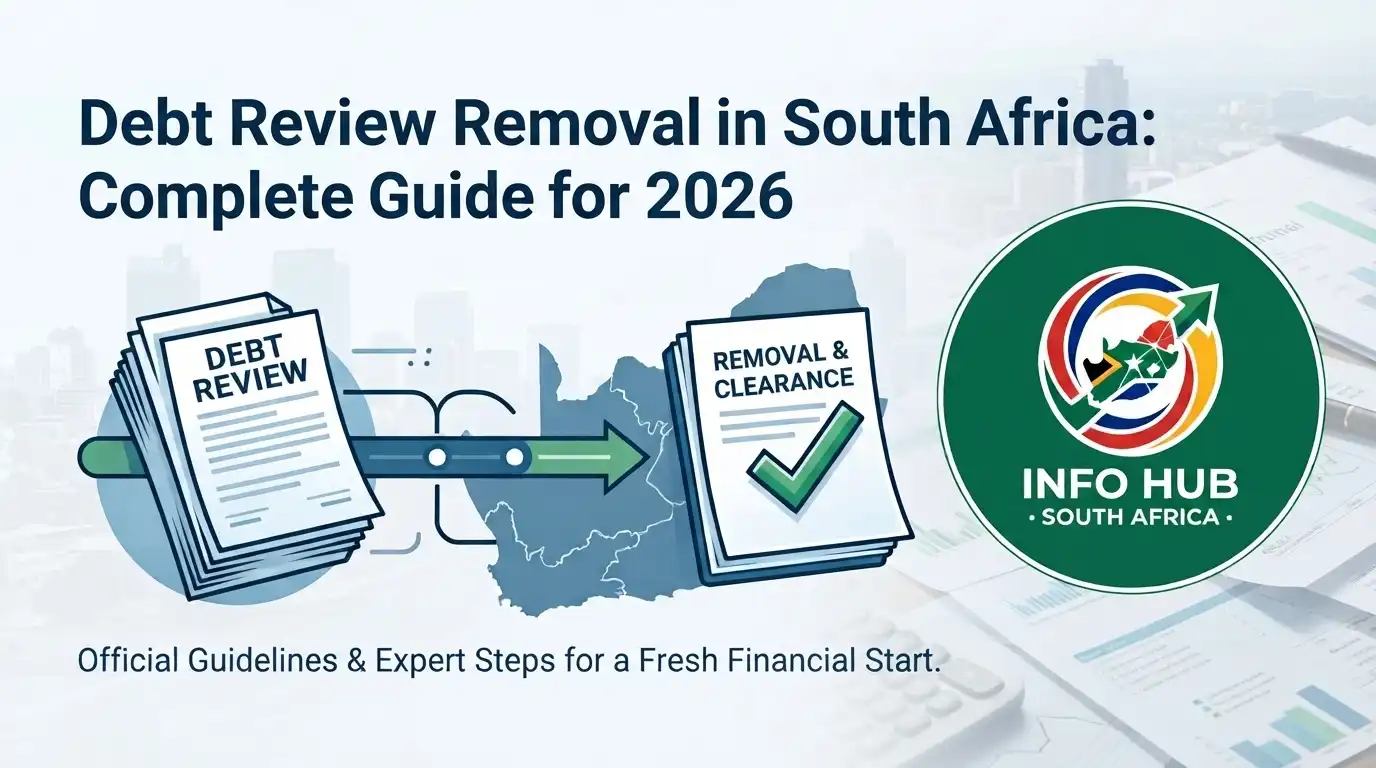
Debt review can provide valuable protection to consumers who are struggling with their monthly credit commitments. It allows an over-indebted consumer to enter a formal debt counselling process, where qualifying debts can be restructured into an affordable repayment arrangement.
The difficulty often comes later. Once your financial position improves and you have satisfied the requirements for leaving debt review, you may want the debt-review status removed from your credit profile.
This is where debt review removal becomes an important issue.
The National Credit Regulator (NCR) regulates the debt counselling industry in South Africa, but consumers should understand that the NCR is not simply a department where you request a button-click cancellation of debt review. The process depends on your circumstances and the legal status of your debt-rearrangement arrangement.”Visit Homepage for more”.
What Does Debt Review Removal Mean?
Debt review removal means that the relevant debt-review information is removed from the consumer’s credit records after the requirements for exiting the debt-rearrangement process have been met.
It is important to distinguish between leaving debt review legally and simply asking a credit bureau to delete a record.
A credit bureau records information supplied through the credit system. It does not normally decide on its own that a consumer has completed debt review. The necessary supporting information must come through the appropriate process.
The NCR’s guidance explains that, after receiving a copy of a valid clearance certificate, a credit bureau or the national credit register must expunge information relating to the relevant debt-rearrangement order or agreement, subject to the requirements of section 71.
Why your credit bureau report matters
Your credit bureau report is one of the most useful documents to check before and after debt review removal.
It can help you determine:
Do not assume that checking one report gives you a complete picture of every credit record. If you are concerned about your profile, check the relevant registered credit bureaus and compare the information.
When Can You Leave Debt Review?
There is no single shortcut that applies to every consumer.
Your route depends on what happened during your debt counselling process, whether a debt-rearrangement order or agreement was made, and whether the requirements for a clearance certificate have been satisfied.
A key provision is section 71 of the National Credit Act. The legislation provides for a clearance certificate where the consumer has satisfied the obligations under the relevant credit agreements or meets the prescribed requirements concerning long-term agreements and the settlement of other obligations.
The usual completion route
For a consumer who has successfully completed the repayment process, the practical sequence is generally:
Debt obligations satisfied → supporting documents obtained → debt counsellor verifies requirements → clearance certificate issued → certificate submitted through the required system → credit records updated
The NCR’s official Form 19 confirms that the certificate is completed on the debt counsellor’s letterhead and identifies the debt counsellor, NCR registration number, consumer and relevant court or tribunal information.
Step-by-Step Debt Review Removal Process
Step 1: Check Your Current Credit Profile
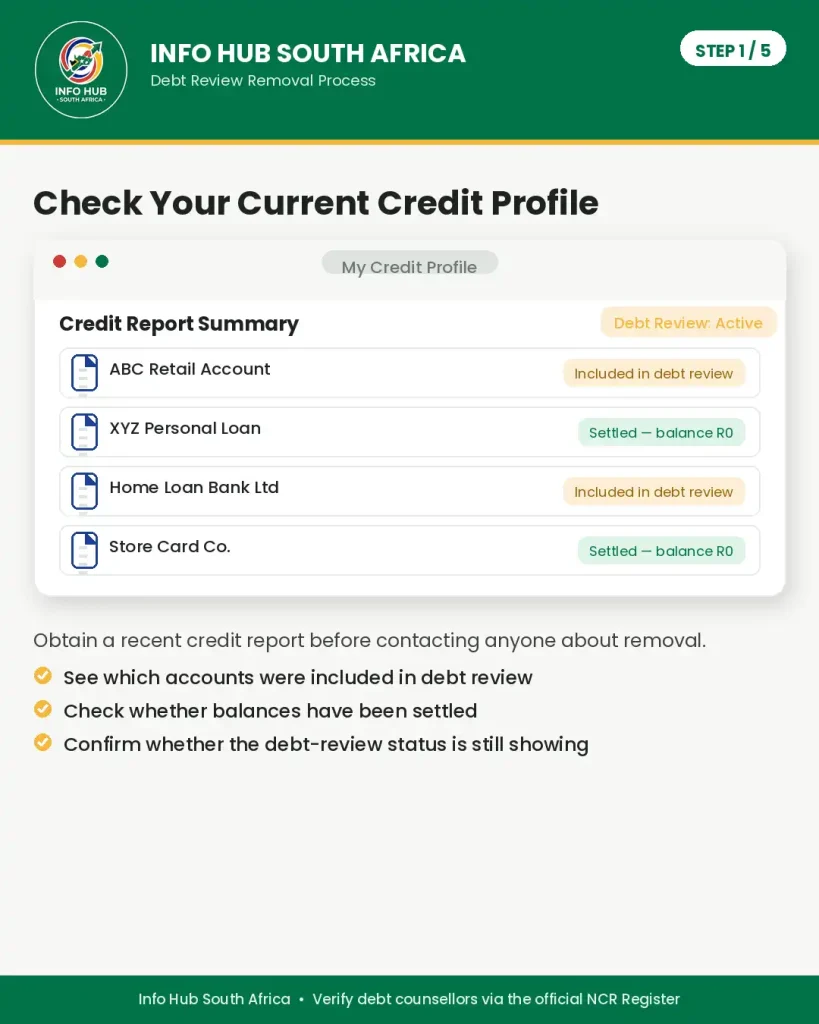
Before contacting anyone about removal, obtain a recent credit report.
Look carefully at the information connected to your debt review. You want to know which accounts were included, whether balances have been settled and whether the debt-review status is still being displayed.
This step can save time because it gives you a record of your current position before you begin the clearance process.
If you discover an error, keep a copy of the report and any supporting documents. This can be useful when communicating with your debt counsellor or a credit bureau.
Step 2: Confirm That Your Debts Meet the Clearance Requirements
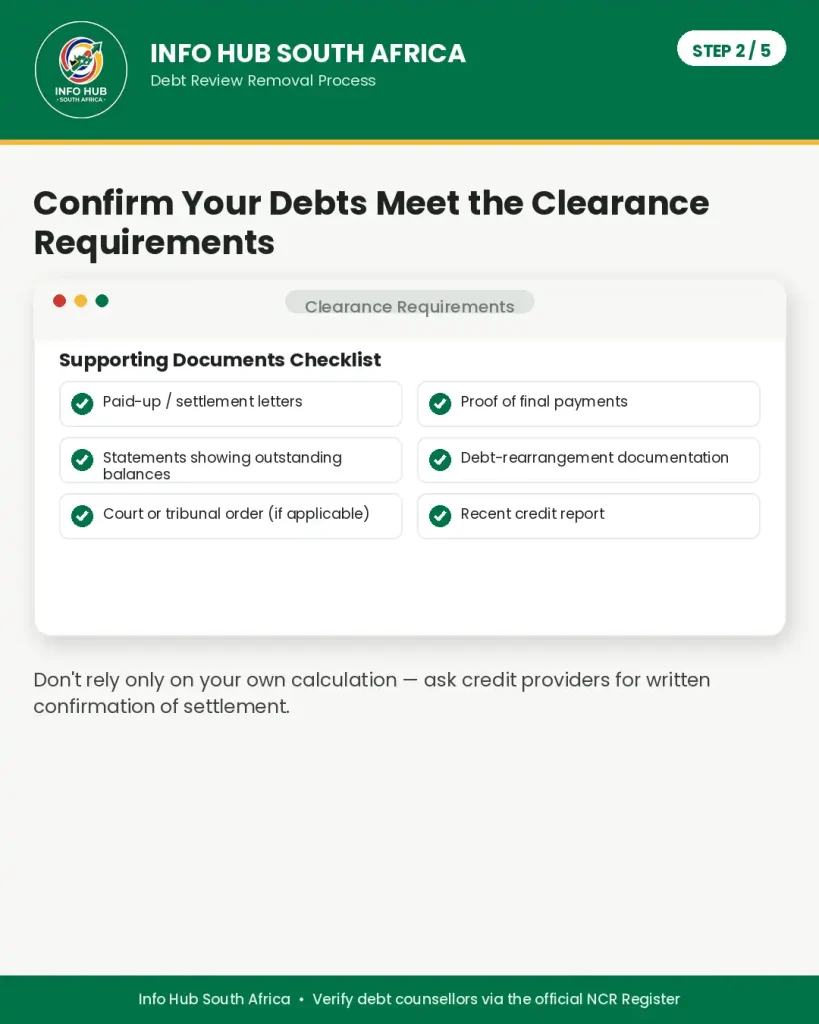
The next step is to determine whether you have actually met the requirements for a clearance certificate.
Do not rely only on your own calculation. Ask the relevant credit providers for written confirmation of settlement where appropriate.
Useful documents may include:
The NCR has previously taken enforcement action where debt counsellors issued clearance certificates without proper evidence that debts had been paid. That is a strong reason to avoid anyone promising an artificial or “instant” debt review removal.
Step 3: Verify Your Debt Counsellor
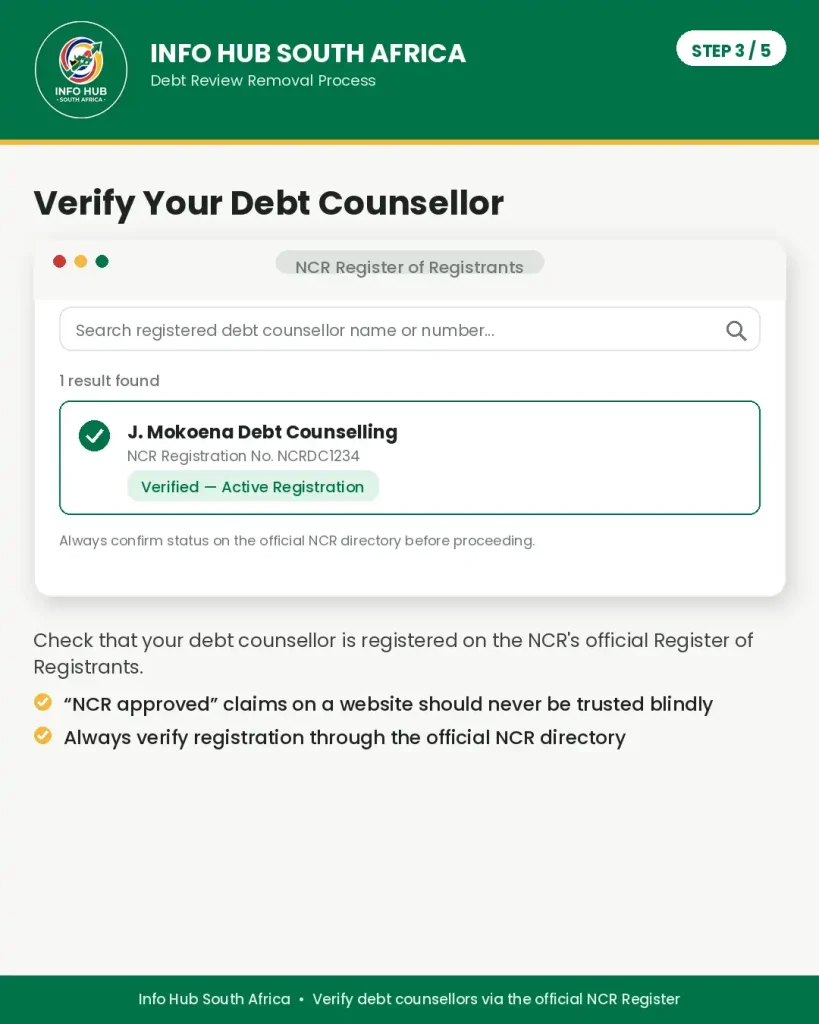
If you are working with a debt counsellor, check that the person or business is registered with the NCR.
The NCR maintains an official Register of Registrants containing registered debt counsellors and their registration information.
This is particularly important when searching for NCR debt counsellors online. A website using terms such as “NCR approved” or “NCR registered” should not automatically be trusted. Verify the registration through the official NCR directory.
Step 4: Ask the Debt Counsellor to Assess Your Case
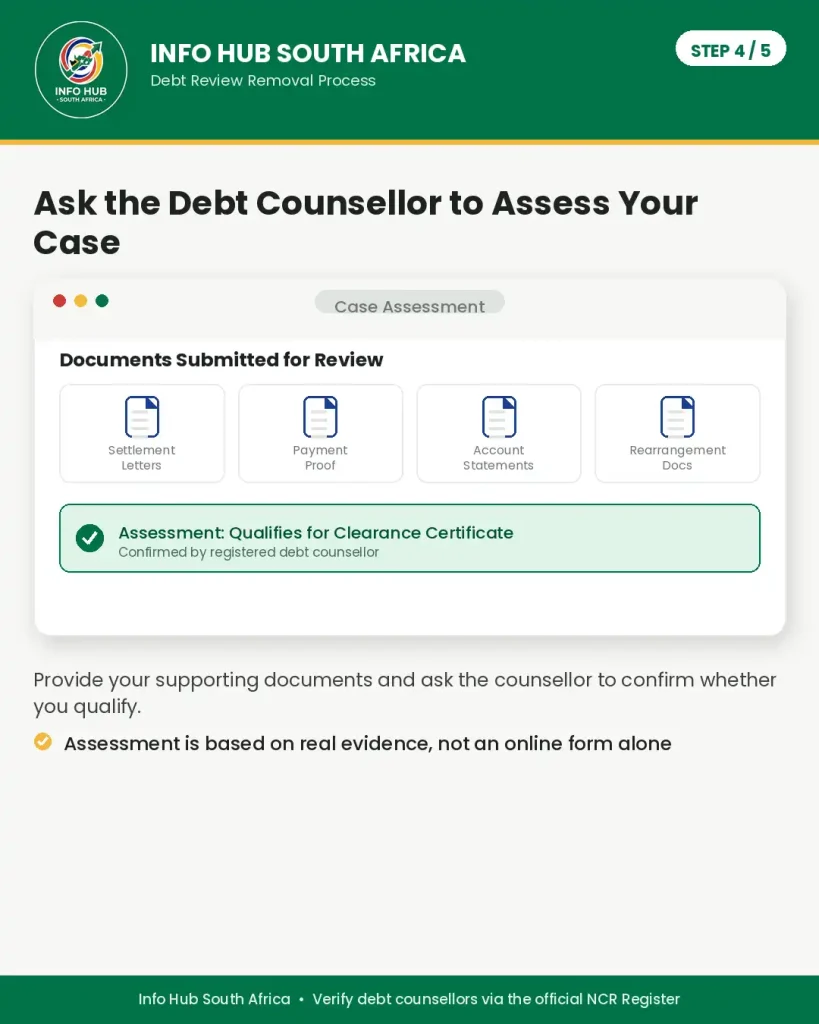
Give the registered debt counsellor your supporting documents and ask them to confirm whether you qualify for a clearance certificate.
Your debt counsellor should assess the relevant debt-rearrangement information rather than simply accepting an online application at face value.
If everything is in order, the appropriate clearance documentation can be prepared.
Step 5: Understand the Form 19 Clearance Certificate
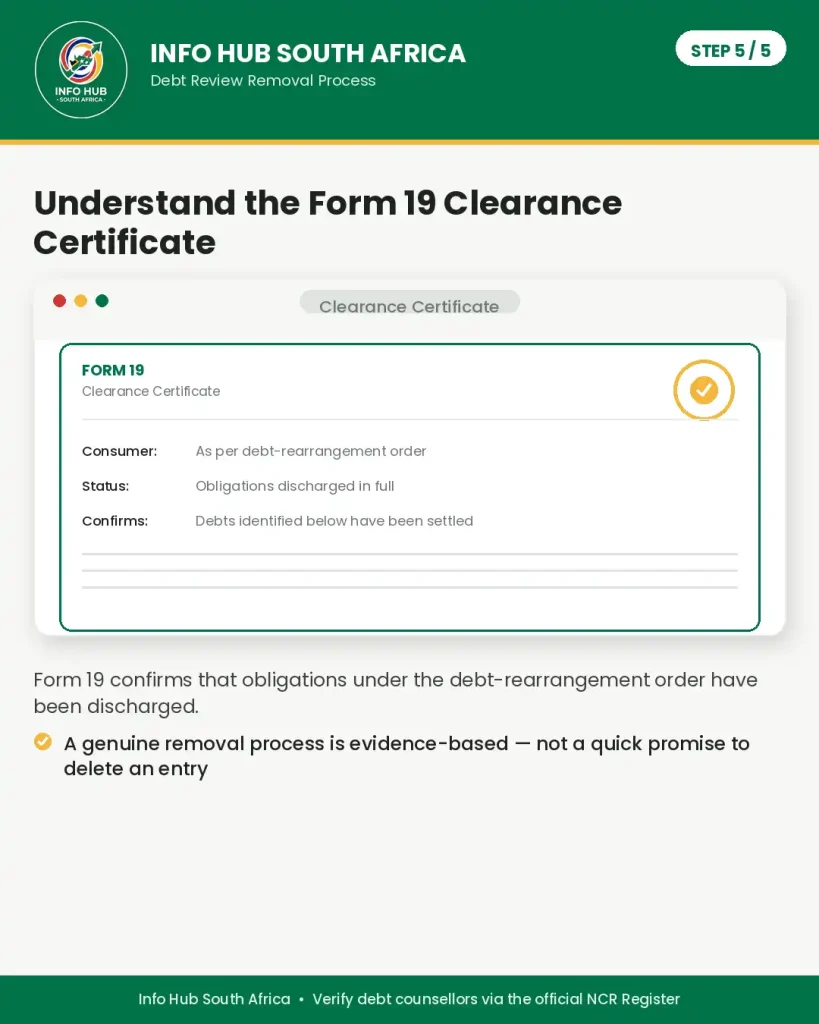
Form 19 is an important document in the debt review completion process.
The official NCR form states that the certificate confirms that the consumer has discharged the relevant obligations under the debt-rearrangement order and identifies the debts that have been settled.
This is why a genuine debt review removal process should be based on evidence rather than a promise that somebody can simply delete an entry from your credit profile.
Important: Be Careful With “Free Debt Review Remove” Offers
The phrase free debt review remove may appear in online searches, social-media advertisements and financial-service promotions. Treat these offers carefully.
“Free” does not necessarily mean that the process is legitimate, and no service should promise that a debt-review status can simply be erased without meeting the legal requirements.
The safest starting point is official NCR information and verification of the registration status of any debt counsellor you intend to use.
Also be careful when searching unrelated terms such as Fasta Loans contact number, NCR careers or NCR contact details. Search results can mix official NCR information with commercial advertisements. Always confirm that you are dealing with the actual organisation you intended to contact.
How the NCR Framework Supports Debt Review Removal
Once you have established that your debts and debt-rearrangement obligations have been dealt with, the next stage is to make sure the supporting information is correctly documented. This is where many consumers encounter delays, especially when paid-up letters, account balances or debt counsellor records do not match.
The National Credit Regulator (NCR) provides regulatory guidance for the debt counselling industry, while the debt counsellor handles the consumer’s clearance process. The NCR’s published Form 19 is specifically used for a clearance certificate issued under section 71 of the National Credit Act.
What Documents Should You Prepare?
Having your paperwork ready can make the debt review removal process much easier. Before asking your debt counsellor to finalise the clearance process, organise the following where they apply to your situation:
| Document | Why It May Be Needed |
|---|---|
| ID document | Confirms the consumer’s identity |
| Recent credit report | Shows the current debt-review status and account information |
| Paid-up letters | Provides evidence that relevant debts have been settled |
| Credit-provider statements | Helps verify balances and payments |
| Debt-rearrangement order or agreement | Establishes the original debt-review arrangement |
| Proof of final payments | Supports evidence of settlement |
| Clearance documentation | Used to update the relevant credit records |
Not every consumer will have exactly the same paperwork. Your registered debt counsellor should tell you which documents are required for your particular circumstances.
What If Your Debt Counsellor Is No Longer Available?
A common problem occurs when the debt counsellor who originally handled the application is no longer operating, is unresponsive or has changed their business arrangements.
Don’t immediately pay an unknown company claiming that it can provide free debt review remove services.
Instead, verify the status of the original counsellor and, where necessary, look for an NCR-registered alternative. The NCR’s register can help consumers identify registered debt counsellors rather than relying solely on advertisements appearing in search results.
When approaching another debt counsellor, explain that you were previously placed under debt review and provide as much historical documentation as you have. This can include your original debt-counselling paperwork, payment records, court documents and credit reports.
Why Verification Matters
Debt review is a regulated process. A company that offers to “delete” the status without checking your legal position should be treated with caution.
The NCR has highlighted the importance of proper procedures surrounding clearance certificates. Consumers should therefore avoid paying for a service simply because an advertisement uses phrases such as “instant removal”, “guaranteed removal” or free debt review remove.
What Happens After a Clearance Certificate Is Issued?
Receiving the clearance certificate is an important milestone, but you should still check what happens to your credit information afterwards.
The NCR’s guidance explains that the credit bureau or National Credit Register must deal with the relevant debt-rearrangement information after receiving a copy of a valid clearance certificate, subject to the requirements of the National Credit Act.
This means your responsibility shouldn’t end when you receive the certificate.
Keep a copy of:
These records can be useful if information remains incorrect and you need to query it later.
Checking Your Credit Bureau Record After Debt Review
After the relevant information has been submitted, obtain another credit report and compare it with your earlier report.
Look for changes in the section relating to debt counselling or debt rearrangement. Also check whether individual accounts have been updated correctly.
If the debt-review information still appears, don’t assume that the clearance process has failed immediately. First establish whether the relevant documents were submitted correctly and whether the bureau has processed them.
You can then raise a dispute with the relevant credit bureau if information on your profile is inaccurate or has not been updated appropriately.
Keep Your Clearance Certificate Safe
Your Form 19 clearance certificate is an important record. Store both a digital copy and a physical copy if possible.
You may need it when dealing with a credit bureau, credit provider or another party that needs evidence that your debt-review obligations have been discharged.
This is especially useful if you later discover conflicting information on different credit reports.
Can You Remove Debt Review Without Paying the Debts?
This is one of the most important questions consumers ask when searching for debt review removal.
Simply wanting the debt-review flag removed does not mean that the underlying obligations disappear.
A consumer should not assume that an online service can remove the status while leaving qualifying debts unpaid. The relevant statutory requirements must be considered before a clearance certificate can properly be issued.
The NCR’s official guidance and forms should therefore be treated as the starting point, rather than claims made by an unverified commercial service.
What About Court-Based Debt Review Removal?
Not every situation follows the same path.
Some consumers believe that they can simply cancel debt review because their income has improved. The legal position can depend on whether a debt-rearrangement order has already been granted and on the facts of the individual case.
If a court order is involved, obtain appropriate legal advice before attempting to terminate or change the arrangement.
A useful distinction is:
Completed debt obligations: The consumer may proceed through the applicable clearance-certificate process when the statutory requirements are satisfied.
Existing debt-rearrangement order: The consumer may need to consider the legal consequences of that order before assuming that debt review can simply be cancelled.
Because the consequences can differ, avoid relying on a generic “one-size-fits-all” debt review removal service.
Common Debt Review Removal Mistakes
Paying an unverified company
Don’t choose a provider simply because it promises the cheapest or fastest removal. Check whether the debt counsellor is properly registered and whether the proposed process makes sense for your circumstances.
Assuming the NCR directly deletes your status
The NCR regulates the industry, but the consumer’s clearance process involves the appropriate debt counsellor and statutory documentation.
Losing settlement evidence
Paid-up letters and proof of payment can become very important if account information later needs to be checked.
Checking only one credit report
Information can differ between credit providers and bureaus. If you are concerned about your profile, review the available reports carefully.
Believing “instant removal” advertisements
A legitimate debt review process is based on the consumer’s actual financial and legal position. A marketing promise cannot replace the statutory requirements.
What Should You Do If the Credit Bureau Still Shows Debt Review?
If your clearance has been completed but your credit bureau record still appears incorrect, work through the issue methodically.
First, compare the current report with the report you obtained before the clearance process. Then confirm that your debt counsellor submitted the necessary documentation and that the certificate details are correct.
If the information remains inaccurate, contact the relevant credit bureau and follow its formal dispute process. Keep copies of the dispute, supporting documents and any response you receive.
If you cannot resolve the matter, consider obtaining professional advice about the appropriate escalation route.
NCR Debt Counsellors: How to Choose One Safely
When looking for NCR debt counsellors, don’t judge a provider solely by its website design, online reviews or advertising claims.
Check the NCR registration information first. Then ask the counsellor to explain:
A professional should be able to explain the process clearly without promising an outcome that has not yet been established.
A Practical Debt Review Removal Checklist
Before moving forward, make sure you have:
This checklist can help prevent avoidable delays and gives you a clear paper trail.
FAQs
Conclusion
Debt review removal should be treated as a formal financial process rather than a quick online service. If you have reached the point where your obligations have been satisfied, the most sensible approach is to organise your documents, work with an appropriately registered debt counsellor and make sure the resulting information is correctly reflected on your credit records.
Be especially cautious about advertisements using phrases such as free debt review remove or promising instant results. Verify NCR debt counsellors, use official NCR contact details when you need regulatory assistance and check your credit bureau report after the relevant process has been completed.
Info Hub South Africa aims to make complicated South African government, education and financial information easier to understand. Always verify important financial and legal decisions against the latest information from the relevant official authority.
Read More
SAPS Vacancies 2026 South Africa: Latest Jobs, Requirements & How to Apply
Home Affairs Online Booking South Africa 2026: Complete Appointment & Application Guide
Matric Results 2026 Online Check South Africa: Get Your NSC Results Instantly
Z83 Form South Africa 2026: Download, Complete & Submit Online
SA Youth Mobi South Africa 2026: Login, Registration & Jobs Guide
SASSA R350 Change Banking Details in South Africa: 2026 Guide