Masters Portal South Africa 2026: Complete Guide to Master’s Degrees & Universities

Choosing a postgraduate degree can be difficult when universities, countries, tuition fees, scholarships and entry requirements all need to be compared. Masters portal brings many of these options together in one place, allowing students to search for and compare Master’s programmes offered by universities around the world.
The platform can be useful for students who already know what they want to study as well as those who are still deciding between countries, universities or fields. The current Masters portal site provides search options for Master’s degrees by study area and country, together with filters for factors such as university, tuition fee, duration, study format and degree type.
For students in South Africa, the masters web portal can also be used to explore both local and international postgraduate opportunities. Masters portal has dedicated information for studying in South Africa, including Master’s programmes, universities, scholarships and application-related guidance.”Visit Homepage for more”.
What Is Mastersportal?
Masters portal is a global education search platform that helps students discover and compare Master’s degree programmes. According to its official About page, the platform focuses on English-taught Master’s programmes and provides information that can help students compare study options worldwide.
Rather than visiting dozens of university websites at the beginning of your search, you can use the masters portal to narrow down programmes according to your preferred subject, country, tuition budget, duration and study format.
The platform is particularly useful during the research stage. However, students should still check the university’s own website before submitting an application because admission rules, document requirements, deadlines and fees can differ between institutions.
What Can You Find on the Masters Web Portal?
The masters web portal can help you research areas such as:
Masters portal’s current platform lists tens of thousands of Master’s programmes worldwide and allows users to narrow results using multiple filters.
How to Create a Mastersportal Account
You don’t necessarily need to create an account simply to begin browsing programmes. However, registering can be useful if you want to save programmes, personalise your search experience or keep track of options.
Step 1: Open the Official Website
Start by opening the official Masters portal website:

Make sure you are using the official domain before entering any personal information.
Step 2: Find the Registration Option
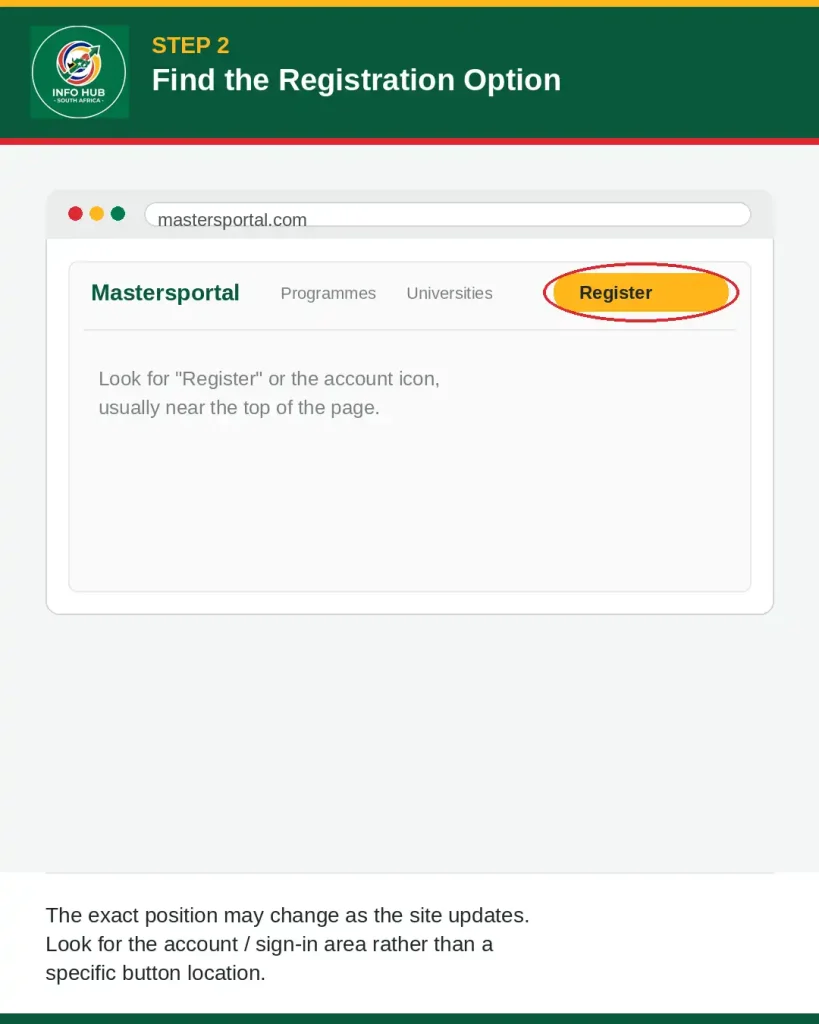
Look for the Register or account option on the website. The exact appearance of the page may change as Masters portal updates its interface, so focus on the account or sign-in area rather than relying on a particular button position.
Step 3: Set Up Your Profile

Where the platform asks for study preferences, provide information that reflects what you are actually looking for. Your preferred subject, destination and study format can make programme discovery more relevant.
For example, a South African student interested in an online Computer Science Master’s could focus their search around:
Computer Science → Online → preferred country or region → suitable tuition range.
Step 4: Save Programmes You Want to Compare

When you find an interesting course, save it so that you can return to it later. Keeping a shortlist is much easier than opening dozens of browser tabs and trying to remember which programmes you considered.
How to Search for a Master’s Degree on Mastersportal
The main purpose of the masters portal is programme discovery. You can start with a broad search and then make it more specific using filters.
For example, instead of searching only for “Master’s degree”, consider entering a subject such as:
Masters portal groups programmes into broad study areas including Business & Management, Computer Science & IT, Education & Training, Engineering & Technology, Medicine & Health, Natural Sciences & Mathematics, Social Sciences and other disciplines.
Use Filters to Reduce the Results
A broad search can return a large number of programmes. Filters help turn that large list into a realistic shortlist.
| Filter | What to Check | Why It Helps |
|---|---|---|
| Field of study | Your subject or specialisation | Removes unrelated degrees |
| Location | Country or city | Helps compare destinations |
| University | Specific institutions | Useful when you have preferred universities |
| Tuition fee | Your available budget | Reduces financially unsuitable options |
| Duration | Programme length | Helps with planning |
| Format | Online, on-campus or other formats | Matches your preferred learning method |
| Attendance | Full-time or part-time | Useful if you work while studying |
| Degree type | MSc, MA, MBA and similar awards | Helps identify the type of qualification |
The current Masters portal search system includes filters for field of study, location, university, tuition fee, duration, format, attendance and degree type.
Mastersportal for South African Students
South African students can use the masters web portal to search for postgraduate programmes within South Africa or investigate opportunities abroad.
Masters portal has a dedicated South Africa study section containing Master’s programme information and country-specific guidance. The platform currently lists universities and programmes across South African cities and disciplines.
This can be useful if you’re comparing local study with international options.
For instance, someone considering a Master’s in Education could compare South African universities, online options and overseas programmes before deciding which applications are worth pursuing. Masters portal currently has separate search results for online Master’s programmes in South Africa as well.
South Africa Search Strategy
If you’re studying from South Africa, don’t select a programme simply because it appears in the search results. Create a shortlist based on:
- Your previous qualification.
- The subject you want to specialise in.
- Whether the university accepts your academic background.
- Tuition and other study costs.
- Delivery format.
- Application deadline.
- Language requirements.
- Whether you need a student visa.
- Scholarship availability.
- Your long-term career plans.
This approach makes the masters office portal search more practical because you are evaluating programmes against your actual circumstances rather than simply choosing the first attractive result.
Checking Master’s Programme Requirements
Finding a suitable programme is only the first stage. The next step is checking whether you are eligible.
Every university can set its own admission requirements, so information displayed on a programme listing should be treated as the starting point for your research. Always follow the university’s official admissions instructions when preparing an application.
Academic Qualifications
Check whether your existing qualification matches the university’s entry requirements.
For a South African applicant, this may involve comparing your Bachelor’s or Honours qualification with the qualification level expected by the overseas university. Do not assume that a qualification is automatically accepted simply because another university accepts it.
Look specifically for information about:
English-Language Requirements
English-language requirements can vary considerably between universities.
Even if you have completed previous education in English, don’t automatically assume that an English-language test will be waived. Some universities may accept previous English-medium study while others may require an approved test or additional evidence.
Check the university’s official admissions page for the exact rule applying to your application.
Application Deadlines
Deadlines deserve particular attention when using the masters portal to search for overseas study.
A programme may look ideal but still be unsuitable if its next intake is already closed. Some universities have multiple intakes, while others accept applications during specific periods.
Create a simple deadline list after selecting your preferred programmes:
| Programme | University | Intake | Deadline | Documents Ready |
|---|---|---|---|---|
| Programme A | University 1 | Autumn | Check official site | Yes/No |
| Programme B | University 2 | Spring | Check official site | Yes/No |
| Programme C | University 3 | Autumn | Check official site | Yes/No |
This prevents an attractive course from being forgotten while you are comparing other options.
How to Compare Master’s Programmes Properly
A common mistake is comparing programmes only by university ranking. Ranking can be useful, but it should not be the only factor.
Use the masters web portal to create a shortlist, then compare each programme using practical criteria.
Course Content
Read the modules and specialisations carefully. Two universities may both offer an MSc in Data Science, yet their course content could be very different.
One programme might focus heavily on machine learning, while another could emphasise statistics, business analytics or research.
Study Format
Think about how you want to study.
An on-campus Master’s may suit someone who wants direct access to university facilities and campus life. An online programme may be more suitable for a student who needs flexibility or wants to remain in South Africa while studying.
Masters portal currently provides online programme searches, including options in South Africa.
Cost
Don’t look at tuition alone.
Your real study budget may also include:
A programme with lower tuition isn’t necessarily cheaper once living and travel costs are considered.
Can You Find Scholarships on Mastersportal?
Yes. Masters portal provides access to scholarship-related information and links to funding opportunities for students considering postgraduate study. Scholarship availability depends on the programme, university, destination and eligibility requirements, so funding should be checked separately for every course on your shortlist.
For South African students, compare the total cost of studying abroad with the value of available funding. A scholarship may cover tuition, living costs or only part of the expenses, depending on its terms.
You can also explore scholarship opportunities through Scholarshipportal, another platform within the Studyportals network.
Tip: Don’t wait until after receiving an admission offer to investigate funding. Many scholarships have their own deadlines, which can be earlier than university application deadlines.
Understanding the Mastersportal Application Process
One of the most important things to understand about the masters web portal is that it is primarily a programme discovery and comparison platform. The application process itself can depend on the university and the particular programme.
When you open a programme listing, look carefully for the available application or programme information options. Depending on the listing, you may be directed towards the university’s own admissions system or an application partner.
What You Should Do Before Applying
Before clicking an application button, prepare a checklist of the requirements.
Academic documents
Personal and professional documents
Additional documents
Requirements differ between institutions, so don’t assume that one university’s checklist applies to every programme you find through the masters office portal.
Applying Through the University Website
After researching a programme on Masters portal, verify the course on the institution’s official website before submitting your application.
This is an important step because the university is the authority responsible for admissions. Its official website should provide the latest information about:
For example, if Masters portal helps you discover a Master’s programme at a particular university, use the programme information to understand the course, then visit that university’s official admissions page to confirm the requirements before applying.
Best practice: Treat Mastersportal as your research and comparison starting point, and the university’s official website as the final source for application requirements.
Mastersportal vs University Admissions Portals
The two should not be confused.
| Feature | Mastersportal | University Admissions Portal |
|---|---|---|
| Find Master’s programmes | Yes | Usually limited to that university |
| Compare different universities | Yes | No |
| Search different countries | Yes | No |
| Save or shortlist programmes | Yes | Usually focused on applications |
| Submit an application | Depends on the programme | Yes |
| Confirm university requirements | Starting point | Primary source |
| Track an institutional application | Not necessarily | Usually yes |
This distinction is especially useful if you are searching for terms such as masters office portal or masters web portal. The name of a platform does not necessarily mean that it is the university’s official admissions office.
How South African Qualifications Fit Into the Search
South African students should pay close attention to qualification requirements when comparing international Master’s programmes.
A university may describe its entry requirement using terminology that differs from South Africa’s qualification framework. Instead of relying only on the degree title, check the institution’s explanation of accepted qualifications and academic levels.
For example, a university may ask for a relevant Bachelor’s degree, an Honours-level qualification or another postgraduate credential. Whether your specific South African qualification meets that requirement must be confirmed by the institution.
If the university requests an academic credential assessment, follow its nominated assessment process rather than choosing an unrelated evaluation service.
Don’t Assume Every Programme Has the Same Entry Standard
Two Master’s degrees in the same subject can have very different requirements.
One may accept applicants with a relevant Bachelor’s degree, while another could require previous postgraduate study, specific modules, professional experience or a research background.
That’s why a good masters portal search should end with an individual eligibility check for every programme you intend to apply for.
Choosing Between South Africa and Overseas Study
Mastersportal can be useful when you are deciding whether to remain in South Africa or study internationally.
An overseas Master’s may provide access to a different academic environment, specialist courses or international experience. On the other hand, studying locally can reduce travel, relocation and living costs and may make it easier to remain close to your existing professional or personal commitments.
There isn’t one universally better choice.
Consider these questions:
Use the masters web portal to compare the available options, but make the final decision based on the programme itself rather than the listing alone.
Common Mistakes to Avoid
Choosing a Course Without Reading the Modules
A programme title can be misleading. Read the curriculum, core modules and optional subjects to see what you will actually study.
Looking Only at Tuition Fees
The advertised tuition amount may not represent your full cost of study. For international students, accommodation, transport, insurance and visa-related expenses can significantly affect the overall budget.
Missing the Application Deadline
Save every deadline immediately after adding a programme to your shortlist. If a university has multiple intakes, check which deadline applies to your intended start date.
Assuming Admission Is Guaranteed
Being able to find a programme through Mastersportal does not mean you automatically qualify for admission. The university assesses your application against its own requirements.
Applying Without Checking the Official University Site
Programme listings can help with discovery, but university requirements can change. Always verify important information through the institution’s official website before paying fees or submitting documents.
A Practical Mastersportal Shortlisting Method
If you are overwhelmed by hundreds of results, use a three-stage shortlist.
Stage 1 — Discovery:
Search broadly by your subject and preferred destination.
Stage 2 — Filtering:
Remove programmes that don’t match your budget, academic background, preferred duration or study format.
Stage 3 — Verification:
Visit each university’s official website and confirm its entry requirements, deadline, tuition and application procedure.
Aim for a balanced shortlist rather than applying everywhere. You might divide your options into programmes that are highly competitive, realistic choices and alternatives that provide a different route towards your postgraduate goal.
What Information Should You Record?
A simple spreadsheet can make your masters portal research much easier.
| Information | Why Record It? |
|---|---|
| University | Identifies the institution |
| Programme | Keeps course names organised |
| Country | Helps with relocation planning |
| Tuition | Supports budgeting |
| Duration | Helps compare study commitments |
| Intake | Identifies your preferred start |
| Deadline | Prevents missed applications |
| Entry requirements | Confirms eligibility |
| Language requirements | Shows whether testing may be needed |
| Application link | Makes the next step easier |
| Scholarship | Helps with funding research |
| Status | Shows whether you have researched or applied |
This approach turns the masters office portal search into a structured application plan instead of a collection of saved links.
How to Use Mastersportal More Effectively
The platform becomes more useful when you search with a specific purpose.
Instead of searching for every Master’s degree available, start with your intended outcome. If your goal is a career in data analysis, for example, investigate related programmes such as Data Science, Business Analytics, Statistics or Computer Science rather than limiting your search to one exact course title.
Likewise, if affordability is your priority, use the available tuition filters and then investigate the total cost of living in each destination.
If flexibility matters, focus on online or part-time programmes. If international experience is your priority, compare destinations first and then narrow the subject results.
The key is to use the masters web portal as a research tool rather than treating its search results as a final recommendation.
Mastersportal Tips for South African Students
A useful strategy is to avoid creating a shortlist based solely on popularity. A Master’s degree should make sense for your previous education, finances and career direction.
If you’re comparing an overseas programme with a South African option, look beyond the headline tuition fee. Consider the complete financial commitment, including accommodation and everyday expenses.
It is also worth keeping copies of every application document in one organised folder. Use clear filenames such as Academic_Transcript.pdf, CV_2026.pdf and Motivation_Letter.pdf. This can save considerable time when several universities request similar documents.
Expert tip: Don’t wait until the final week to prepare an application. If a university requires references, certified documents or a research proposal, those items may take longer to arrange than the online application itself.
Mastersportal vs Direct University Search
Both approaches have a place in your research.
Using Mastersportal first can save time because you can discover programmes across different institutions and countries in one place. Searching university websites directly becomes particularly important once you’ve identified the programmes you are genuinely interested in.
A practical workflow is:
Discover → Compare → Shortlist → Verify → Prepare → Apply
This gives you the convenience of a masters web portal while still relying on the university’s official information for the final application decision.
Final Mastersportal Application Checklist
Before submitting a Master’s application, confirm each of the following:
FAQs
Conclusion
Mastersportal can make postgraduate research much more manageable by bringing Master’s programmes from different destinations into a searchable comparison environment. For South African students, it can be a useful starting point for exploring local degrees as well as international study opportunities.
The best approach is not to apply simply because a programme appears in the masters portal results. Use the platform to discover possibilities, narrow down your choices and build a shortlist. Then verify admission requirements, fees, deadlines and application instructions directly with each university.
If you’re searching for a masters web portal or masters office portal, remember that programme-search platforms and university admissions systems serve different purposes. Once you’ve selected a course, move to the institution’s official website for the authoritative application information.
For readers of Info Hub South Africa, the most useful strategy is simple: research widely, compare carefully and verify everything important before submitting an application.
Read More
Majuba Student Portal South Africa 2026: Student Login, Registration & Complete Portal Guide
Matric Results 2026 Online Check South Africa: Get Your NSC Results Instantly
CUT Status Check South Africa 2026: Complete Application and Admission Guide
Sol Plaatje University Online Application 2026 South Africa: Complete Step-by-Step Application Guide
TUT Late Applications 2026 in South Africa: Complete Guide to Apply Before the Closing Date
UP Portal South Africa: University of Pretoria Login & Student Guide